As we argued in our founding manifesto, Africa’s climate-finance problem is not simply a shortage of capital, it is also a shortage of investment-ready projects capable of absorbing that capital. A new financing platform from Africa Finance Corporation (AFC) and the Green Climate Fund (GCF) is attempting to address both sides of that problem.
The Africa Sovereign Climate Facility (ASCF) has been announced as a US$690 million programme, initially targeting Angola, Benin, Côte d’Ivoire and Nigeria. It will support investments across clean energy, food and water security, and climate-resilient infrastructure. The size of the programme is worth noting. But to understand what it could achieve, we need to look more closely at the financing.
A closer look at the capital structure
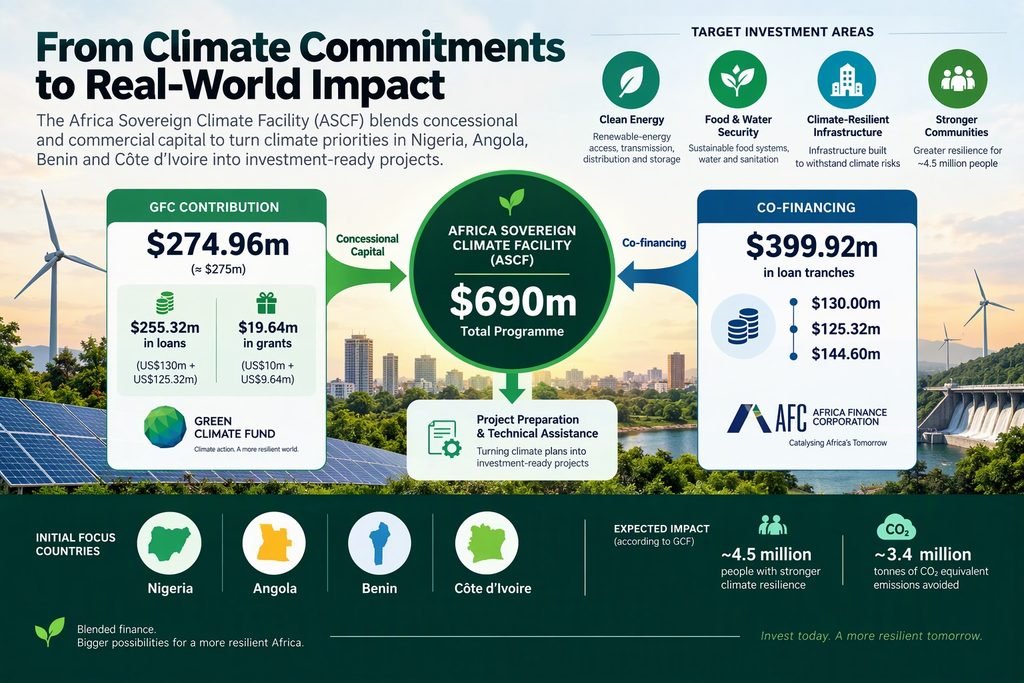
AFC’s announcement puts GCF’s contribution at US$280 million. The detailed GCF project record gives a more precise approved amount of about US$274.96 million, alongside approximately US$399.92 million in co-financing. That co-financing comprises three loan tranches: US$130 million, US$125,321,493.36 and US$144,601,723.37.
GCF’s own contribution of $274.96m combines loans and grants:
- The loans amount to approximately US$255.32 million, comprising US$130 million and US$125.32 million.
- The grants total approximately US$19.64 million, comprising US$10 million and US$9.64 million.
This is what makes the facility interesting from a capital perspective. The aim is not simply to spend concessional climate money. It is to use that capital alongside other financing and AFC’s project-development capabilities to create a larger investment pool. Some of the grant funding will also address a less visible, but essential, part of the process: preparing projects well enough to secure financing.
Moving from climate plans to transactions
African governments have Nationally Determined Contributions, adaptation plans and substantial infrastructure needs. These set out priorities, but they do not, on their own, make a project investable.
A transmission network still needs engineering studies and a sound financing plan. A water project needs a workable delivery model. Climate-resilient infrastructure requires clear procurement arrangements, sensible risk allocation and the capacity to see the work through.
This is the practical gap between climate ambition and bankability. It is also where the ASCF could make a meaningful difference.
According to GCF, the grants will fund technical assistance to refine priority investments, bring climate considerations into macroeconomic and fiscal planning, and strengthen monitoring. Financing for eligible projects will then flow through the participating governments’ finance ministries. The eligible investment areas range from renewable-energy access and electricity transmission, distribution and storage to food systems, water and sanitation, and climate-resilient infrastructure.
The approach brings project preparation and financing into the same framework, rather than treating them as separate exercises.
Why blended finance makes a difference
Although their economic circumstances differ, the four countries share several constraints identified by GCF: limited fiscal space, high financing costs and insufficient integration of climate priorities into national investment planning. Commercial capital alone is unlikely to overcome these barriers.
Concessional funding can help improve project economics, pay for preparation and reduce some of the risks that keep other investors away. The question, then, is not just whether the facility deploys US$690 million, but how much additional investment each dollar of concessional capital can help attract.
That is a more demanding test of blended finance, and a more useful one.
The real test lies ahead
GCF estimates that the programme could strengthen the climate resilience of approximately 4.5 million people and avoid around 3.4 million tonnes of CO₂ equivalent emissions. Those are important targets, but they are not the only outcomes worth watching.
A further test is whether the facility can produce financing structures that others can replicate and scale, with less reliance on concessional support over time.
The programme received GCF Board approval on 28 October 2026. GCF’s project record currently indicates that implementation has not yet started, so the facility’s promise still needs to be tested in practice.
At Africa Green Capital, we will be watching which projects secure financing and how quickly they reach financial close. We will also look at the risks concessional funding absorbs, the additional capital it mobilises and whether successful structures can work elsewhere.
If the ASCF delivers on those measures, its significance will extend beyond the announced US$690 million. It could demonstrate a repeatable way to turn sovereign climate priorities into investable assets.
That would be a worthwhile contribution, offering not just more capital for Africa’s climate priorities but a clearer route from funding commitments to projects that get built.
#AfricaGreenCapital #ClimateFinance #BlendedFinance #GreenCapital #Africa #SustainableFinance #GCF #AFC